WINDLESS FROM GIZO TO CONFLICT BAY

That afternoon we anchored at Rendova Island inside a protected lagoon.  It was still raining heavily and two girls (Sisters) came out to visit in a canoe, they were completely bedraggled and shivering cold.  They brought the most appealing and healthy vegetables I have ever seen.  Despite the cold and rain they were cheerful and happy to trade.  As they had such amazing produce and had endured the weather to get to me I gave them more than I probably should have.  But they were delightful young ladies and cheered me up.  We were both happy with the trade and that’s all that matters.     

ARRIVED GIZO – EXHAUSTED

As I was daydreaming, I suddenly noticed the depth sounder was reading 5 meters!  Immediately I put the engine into neutral and we slowed, as we slowed the depth reduced, I gave a kick astern and we stopped.  The depth now read zero, that means nothing under the keel!  I checked everything, a flashlight over the side, we should be in deep water.  Then I realised my mistake.  I was so tired and my brain so befuddled, I had been reading the wind instrument instead of the depth sounder.  As we reduced speed so the relative wind reduced to zero as we stopped.  Clearly, I had not been thinking straight.  I was very tired.

BEATEN BACK BY THE CURRENT AND FICKLE WINDS

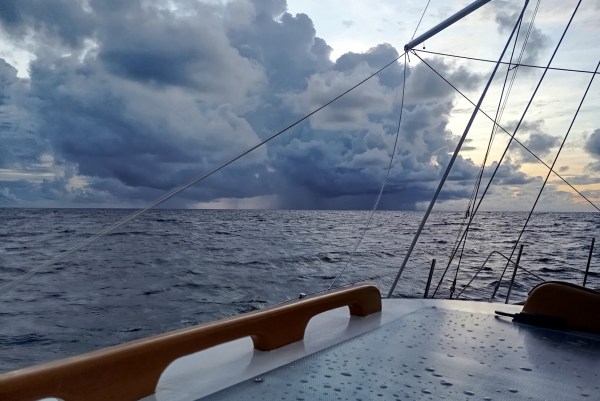
Departing Kavieng was hard work, a light onshore wind threatened to put us onto a lee shore, thankfully the wind freshened a bit, allowing us to head away and clear the land. Then the wind died and the current pushed us westwards, losing ground and making interesting track patterns on the navigation plotter. There followed a series of squalls making for uncomfortable sailing, on a positive note I was able to fill the water tanks with nice fresh rainwater. This carried on for two days, yo-yoing back and forth with the squalls but slowly making progress eastwards.

Repairs and Maintenance in Puerto Princesa

I have made the horrific discovery of some wet wood in the rudder.  The rudder construction is a sandwich with red cedar on the outside and laminated ply in the centre.  Water has got into the central ply section from the tiller pocket and travelled, as it does, down through the ply.  Luckily, I have discovered it early and after extensive prodding and digging around I can see the end of it.

Blog at WordPress.com.

Up ↑